Amateur Astronomers Using Artificial Intelligence Find Candidate Dwarf Planet in Public Telescope Data
- TDS News
- Science
- November 29, 2026
By Editorial Board
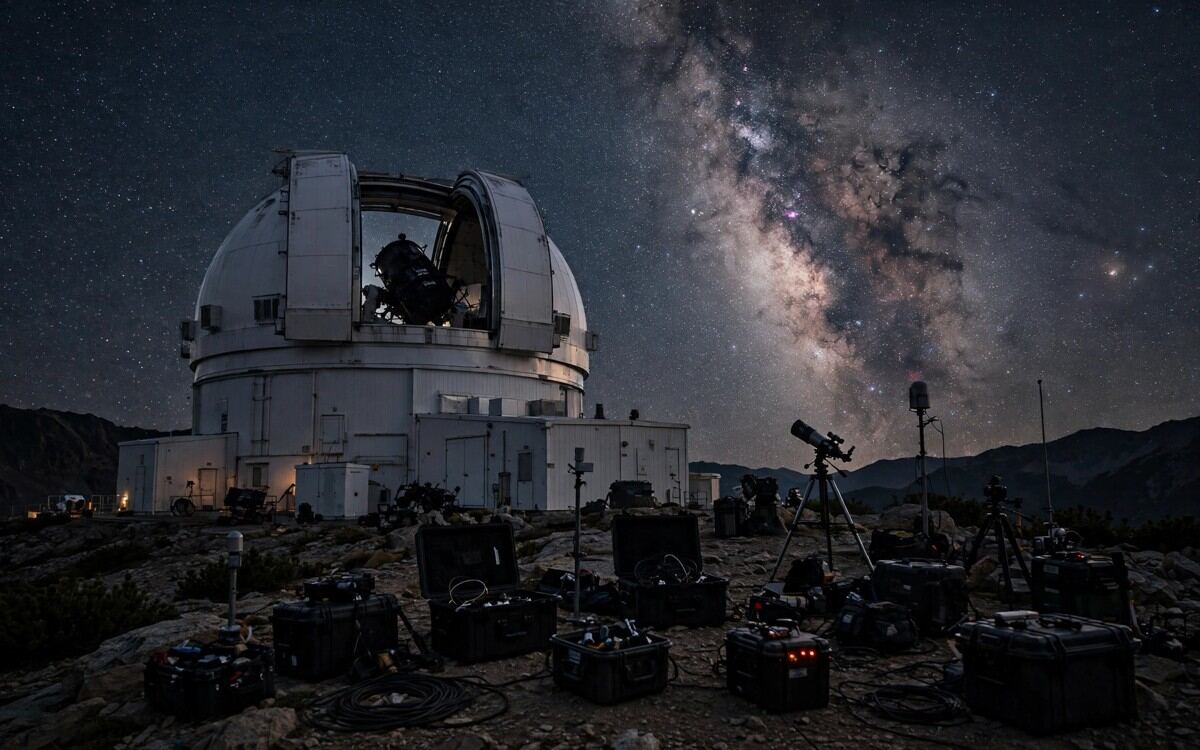
Amateur astronomers using commercial artificial intelligence tools say they have found a candidate dwarf planet hidden in public telescope data, in a discovery reported on November 29, 2026 by Scientific American. Software engineers Joshua Wolk and Luke Farritor worked with artificial intelligence researcher Will DePue and used Anthropic Claude models to help write code that searched early data from the Vera C. Rubin Observatory in Chile. The observatory captured those views of the southern sky in April and May 2025 during its commissioning phase, and the data were placed online where anyone could study them.
The team chose a crowded region of sky near the galactic plane, a region other observatories had mostly passed over because dense fields of background stars make faint and distant objects hard to pick out. Before the new find, the group had already used artificial intelligence to plot 400 of the thousands of known objects that orbit beyond Neptune. Their code first detected signs of the candidate in the Rubin data, and they then confirmed the signal by matching roughly 50 billion potential orbits to objects recorded in archived images from earlier telescope surveys.
Mario Juric, an astronomer at the University of Washington who leads the Rubin Observatory Solar System Operations Team, inspected the images and ran the data through Rubin verification systems. He confirmed that the newly found object beyond Neptune is probably real, and he said the discovery shows that people outside the professional teams can find things that professionals miss.
Judging from its brightness, the object is about 365 miles across, or 590 kilometres, which could be large enough for gravity to have pulled it into a spherical shape. A round shape produced by its own gravity is an essential requirement for a dwarf planet. Its eccentric orbit carries it between 32 and 79 astronomical units from the Sun, roughly between three billion and 7.3 billion miles, and it is now near its greatest distance from the Sun. The candidate has yet to be formally recognised by the International Astronomical Union, the body responsible for official recognition of such objects.
The candidate arrives only weeks after a professional team led by Harvard University astronomer Matthew Holman announced a different dwarf planet candidate in Rubin data from the same patch of sky. That earlier candidate was found with a traditional search using computer algorithms rather than artificial intelligence. Holman welcomed the new approach while noting that it is not yet clear exactly how the artificial intelligence assisted search was achieved. He said Claude is particularly strong at combining established methods with extensive knowledge of the relevant scientific literature, and he noted that the models likely drew on open source software tools that he himself built to find such candidates.
Juric said half a dozen amateur researchers contacted him in the past week about potential discoveries pulled from the Rubin data with artificial intelligence, a sign of how quickly the tools are spreading. Wolk believes there are many more objects beyond Neptune yet to be found in the same neglected patch of sky, and he is already trying to recover a few of them. The region is home to hundreds of thousands of orbiting ice and rock objects, along with dwarf planets like Pluto, in what is known as the Kuiper Belt. Professional astronomers describe those objects as cosmic fossils that preserve clues about how the solar system evolved, including how Jupiter, Saturn, Uranus and Neptune formed closer to the Sun and later moved outward into their present orbits.
About The Author